Martin Mangold, April 6, 2026
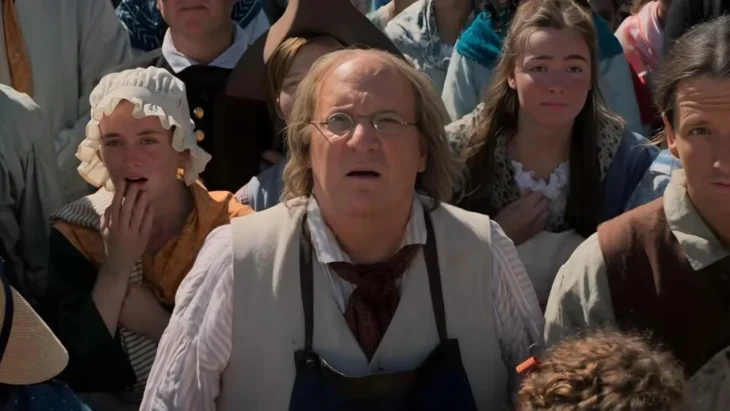
I had a good feeling from the trailer. The production elements were wonderful. It strikes a respectful tone towards Franklin and George Whitefield, the itinerant preacher that Franklin befriended.
The movie delivers a deeply satisfying depiction of the episode Franklin described in his Autobiography:
He had a loud and clear Voice, and articulated his Words and Sentences so perfectly that he might be heard and understood at a great Distance, especially as his Auditories, however numerous, observ’d the most exact Silence. He preach’d one Evening from the Top of the Court House Steps, which are in the Middle of Market Street, and on the West Side of Second Street which crosses it at right angles.
Both Streets were fill’d with his Hearers to a considerable Distance. Being among the hindmost in Market Street, I had the Curiosity to learn how far he could be heard, by retiring backwards down the Street towards the River, and I found his Voice distinct till I came near Front-Street, when some Noise in that Street, obscur’d it.
Imagining then a Semi-Circle, of which my Distance should be the Radius, and that it were fill’d with Auditors, to each of whom I allow’d two square feet, I computed that he might well be heard by more than Thirty-Thousand.
The film is beautiful, if you don’t think about it too much. But I wondered who is telling this story, and what are they trying to tell us? In this case, the answer lies with the question: how do they end it?
Whitefield was a Christian evangelist, and Franklin was his business partner. I think Franklin saw the power of a charismatic preacher to persuade and move multitudes of people, and he recorded these observations like he recorded seeing other marvels of nature.
Franklin himself grew tired of metaphysical speculations, as he wrote to Benjamin Vaughan:
The great Uncertainty I found in Metaphysical Reasonings, disgusted me, and I quitted that kind of Reading & Study, for others more satisfactory.
We know Franklin’s specific thoughts about Christianity at the end of his life, from a March 1790 letter to Ezra Stiles:
As to Jesus of Nazareth, my Opinion of whom you particularly desire, I think the System of Morals and his Religion as he left them to us, the best the World ever saw, or is likely to see; but I apprehend it has received various corrupting Changes, and I have with most of the present Dissenters in England, some Doubts as to his Divinity: tho’ it is a Question I do not dogmatise upon, having never studied it, and think it needless to busy myself with it now, when I expect soon an Opportunity of knowing the Truth with less Trouble. I see no harm however in its being believed….
The production company, Sight & Sound, operates as a Christian theatrical company. The overall tone is reminischent of the early mythologizing biographies of Franklin and the other Founders. This raised questions for me: while obviously admiring Whitefield, how will they handle his troubling relationship with slavery? How will the overtly Christian viewpoint of the film handle the spiritual distance between the two men? As the movie progressed, I wondered how will they frame Franklin’s failed proposal for prayers in the Constitutional Convention of 1787? Will these matters be ignored, resolved, or simply presented?
I found the depictions of Whitefield and Franklin to be very sympathetic. I found all of it visually authentic and pleasing. To see the brick tunnel of Franklin Court with a brick building behind it was a thrill.
One error I caught in the movie was my own. I thought it was incorrect for Franklin to use the term “data,” but this was my oversight. Franklin used the term in a 1781 letter to John Adams exactly as we use it today: ” … I am furnished with none of the Data on which to found an Opinion…” .
Some creative license went a little too far, but did not break me. In the scene at Bristol on November 8, 1739, the workers at the coal mine throw stones at first, but are won over by Whitefield’s wonderful preaching. We have festive baptisms in the water tanks. I had to ask: does this coal mine have no supervisors, no management? Do we all get the afternoon off for ecstatic conversion? The camera swooping into the tunnels won me over, and I set my concerns aside.
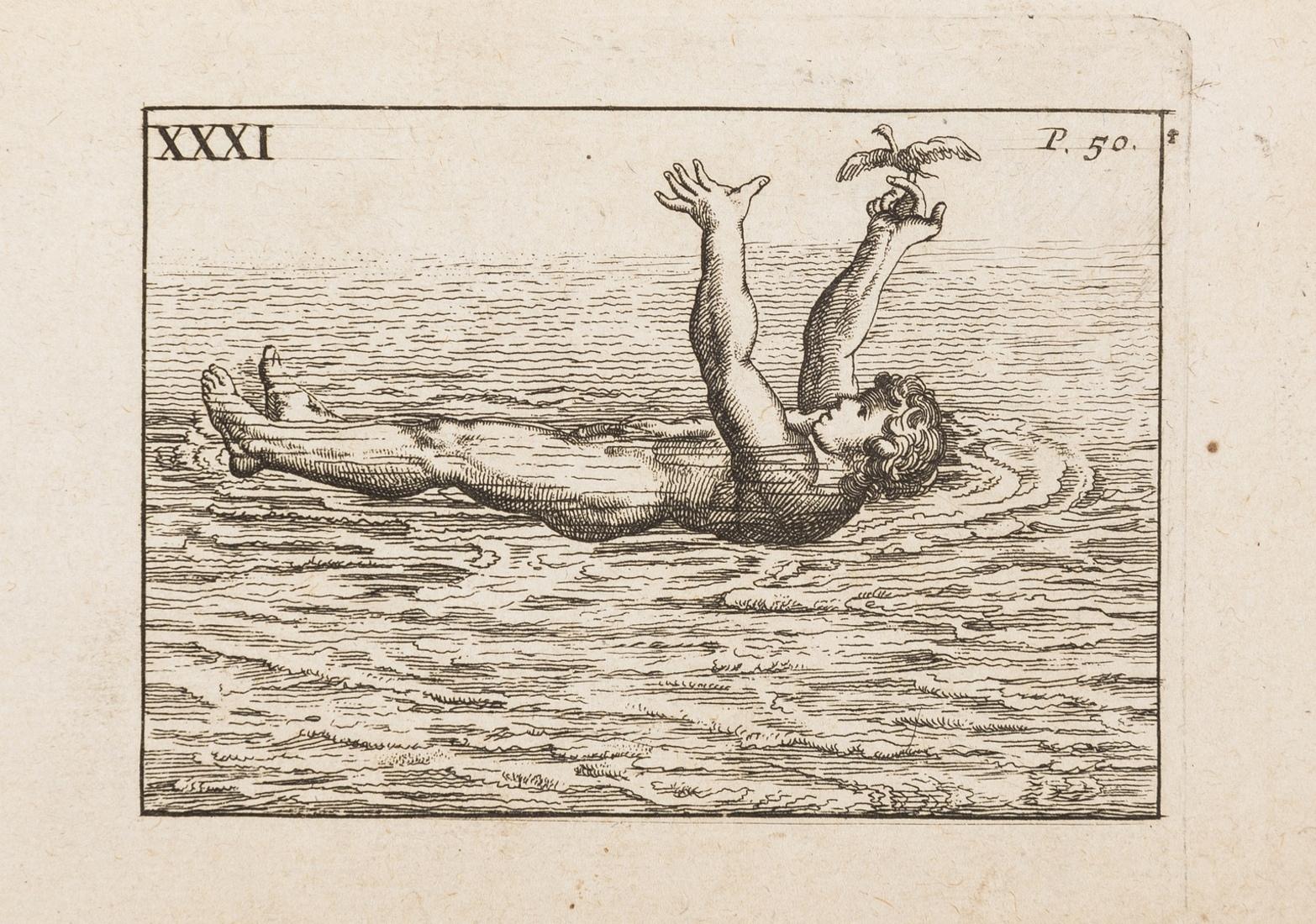
There’s some creative license I enjoyed: Franklin making an origami kite during the tedious debates of 1787, leads to a flashback to the childhood kite on the pond (referred to here as a “lake”).
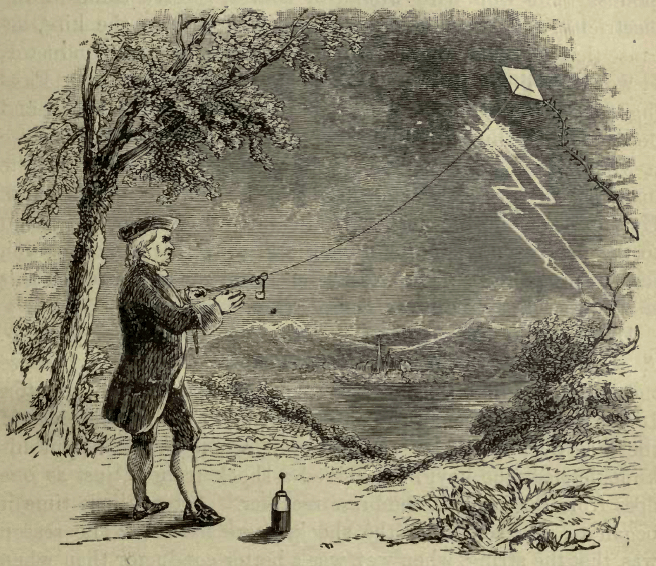
The idea that as an adult in Philadelphia, after the 1752 experiment, Franklin kept a kite ready to take out and fly in thunderstorms is too fun to quibble with.
There is a wonderful argument scene, placed in the Assembly Room of Independence Hall, between Franklin and Whitefield. The two men have it out: Whitefield says Franklin has failed to find faith, and Franklin says Whitefield should leave him alone. They missed the chance for this exchange:
- Whitefield: “Didn’t you say that it’s hard for an empty sack to stand upright? Without Jesus, you are an empty sack!”
- Franklin: “I was referring to having money, and I’m standing up just fine.”
As it is, they gave Franklin a nice line, along the lines of “I’ve never tried to change you – why are you trying to change me?”
Trouble Approaches
The train starts leaving the tracks as we approach the end. Franklin has a tearful, anguished epiphany in the rain, and returns to write his Proposal for Prayers in the Continental Congress. This is a big stretch for me, as the general attitude is that Franklin made this proposal strategically, to get the religious and recalcitrant members of Congress to relax a little.
The presentation of Franklin’s Proposal for Prayers in Congress on June 28, 1787 is beautifully presented. It includes, one of the best lines, referring to God:
And if a Sparrow cannot fall to the Ground without his Notice, is it probable that an Empire can rise without his Aid?
In my opinion, the word if does a lot of work here: Franklin is appealing to anyone who already believes in God’s intervention. Franklin’s own viewpoint goes back to his Articles of Belief and Acts of Religion, written at age 22, dated 20 November 1728.
Also, when I stretch my Imagination thro’ and beyond our System of Planets, beyond the visible fix’d Stars themselves, into that Space that is every Way infinite, and conceive it fill’d with Suns like ours, each with a Chorus of Worlds for ever moving round him, then this little Ball on which we move, seems, even in my narrow Imagination, to be almost Nothing, and my self less than nothing, and of no sort of Consequence.
When I think thus, I imagine it great Vanity in me to suppose, that the Supremely Perfect, does in the least regard such an inconsiderable Nothing as Man. More especially, since it is impossible for me to have any positive clear Idea of that which is infinite and incomprehensible, I cannot conceive otherwise, than that He, the Infinite Father, expects or requires no Worship or Praise from us, but that he is even infinitely above it.
After his motion for prayers is rejected, the movie declares victory and starts closing the curtain. That’s where the trouble really hits.
Scrolling text informs us that
- Franklin’s proposal coincided with the Congress’ deadlock evaporating, and
- the Constitution was ratified shortly thereafter, as a result, and
- ever since, the Congress has in fact had prayers at the opening of sessions, and this practice continues to this day.

My favorite visual moment takes place at this point, behind the final credits: we see a long study of a sun rising over the open sea. As the names of forty thousand cast members scroll by, the sun rises above the horizon. It is so generous and beautiful that those earlier bullet points can settle in for a few minutes. We are soothed as we speak up the idea that Franklin was saved by Jesus enough to shove this country into communication with God, and God has been guiding this nation ever since.
This movie has now gone a long ways away from Franklin, who in 1776 changed Jefferson’s words “We hold these truths to be sacred and undeniable” into “We hold these truths to be self-evident.” Jefferson had suggested with the word “sacred” that we know what is sacred, and if you disagree, you are wrong. Franklin steered the Declaration specifically away from God’s inspiration to stating things that were scientifically true: if you don’t agree, go and look for yourself.
The movie’s messaging is troubling on several fronts:
- Whitefield seems to have persuaded Franklin to become a Christian in the sense advocated, a personal, direct relationship with Jesus. The film treads lightly on this point, blending Franklin’s esteem for Whitefield with Christianity itself.
- God’s inspiration, reaching through Whitefield and Franklin, gave Americans the wisdom and courage to seek independence from Britain (this from Franklin’s chess game conversation with one of the Howe brothers).
- Franklin’s proposal for prayers ended the deadlock of the Constitutional Convention. I’ve never seen that idea put forth: the compromises around slavery, and around representation of larger and smaller states are generally given credit for that.
- Franklin’s proposal for prayers established a Christian relationship between the Government and God that is still in effect.
This last idea implies that whatever the Government does is right, and authority flows from God through the government and through the government to the people. It reverses the fundamental idea of the Constitution, that the people give authority to the government. Whitefield complained that the religion he found in England was “dead,” so the British government lacks the inspiration that we have from our direct and “living” faith.
The concluding point of the movie seems to be that since heavenly inspiration through Congressional prayers is guiding our government, our only task now is to follow our national leadership.
Franklin noted “various corrupting Changes” to the Christian story, and I see this movie as a corruption of Franklin and Whitefield’s story in the direction of theocratic government. It is a disservice to both of their legacies.
See Also
- YouTube: Great Awakening Trailer (Sight & Sound website)
- Franklin to Vaughan, 9 November 1779.
- Franklin to Adams, 26 November 1781.
- Franklin to Ezra Stiles, 12 March 1790.
- Autobiography, Part 12 (on Whitefield)
- Locating Franklin’s Print Shop (posting 9 October 2023)
- Whitefield Statue Removal (posting 15 July 2020)
- Glenn Eischelman leaving Sight & Sound, 2013 (Lancaster Online). Glenn & Shirley Eschelman are prominently credited in the film.